

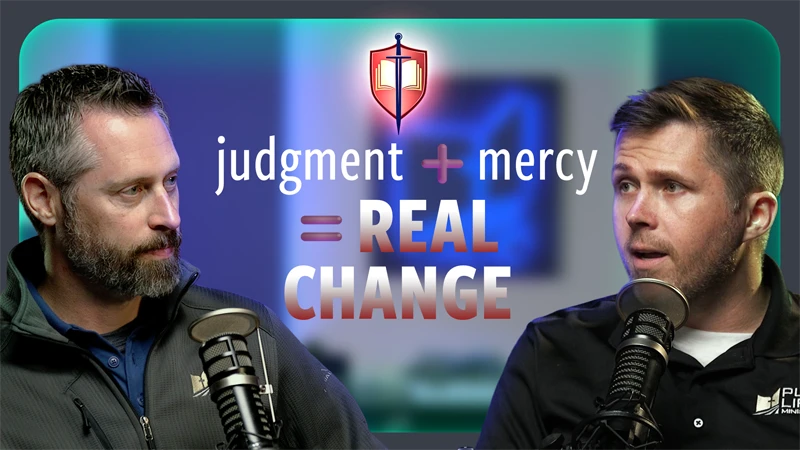
Judgment + Mercy = Real Change | Micah 7:18-19 | Truths for Victory
In this Truths for Victory bonus segment, Josh and Patrick unpack the incredible promise found in Micah 7:18–19. But for that promise to shine brightly, it must first be set against a dark backdrop: the reality of future judgment.
Sin has consequences—consequences that must be felt and allowed if real change is to take place. Praise God for His incredible grace!
Josh: All right, Patrick and I are back again to talk more on the Truths for Victory series.
Patrick: We are.
Josh: We're here and we're going to try to get through another conversation.
Patrick: They don't know that this is your third or fourth time trying to start this.
Josh: I mean, they don't have to know that. They really don't, but I guess they do now.
We're going to be talking about Micah 7:18-19. So, I'm going to read it and then we're going to talk about the context of this and then we're going to get into some application of it later. So let me go ahead and read it. Micah says, “Who is a God like You, who pardons iniquity And passes over the rebellious act of the remnant of His possession? He does not retain His anger forever, Because He delights in unchanging love. He will again have compassion on us; He will tread our iniquities under foot. Yes, You will cast all their sins Into the depths of the sea.” (Micah 7:18-19, NASB 1995) So Patrick, why don't you go ahead and share with us some of the context?
Patrick: This is only seven chapters long, so I read through the whole thing. And I don't want to give a detailed analysis for our listeners, but I would encourage them that if they took seven days to study this, it would do them some good and they’d get a lot out of it. But essentially, this book reminds me a lot of Isaiah. Micah is prophesying at the same time. You see in verse one the same kings that Isaiah lived during. He's prophesying to both nations. And similar to Isaiah, in that book, you have these recurring themes of judgment and hope. And that's what you see here in the first few chapters – a lot of judgment for the way people are living.
They are living in rebellion against the Lord. But there is hope that God is going to bring redemption. And I love, in Isaiah, it kind of happens towards the end of the book, where you start seeing that just because the Lord is bringing salvation doesn't mean there's cheap grace and you can just live how you want. You have to begin living rightly. And that's kind of what chapter 6 does here. There's the famous verse, “And what does the LORD require of you But to do justice, to love kindness, And to walk humbly with your God?” (Micah 6:8b, NASB 1995) So, there's this kind of call that if you are going through judgment and experiencing salvation, it has to change how you live. So that's what stood out to me when reading the book of Micah.
But the way it struck me was that our sin has consequences. The way Biblical scholar Dr. John Oswalt puts it is that Israel was being saved through judgment. They couldn't get around it. It was coming because of the actions that they had committed. And for me, I just wanted to bring things to my own experience and the experience I've seen for a lot of other people. I sinned. I was hiding it behind people's backs. And when I confessed it to my pastor, I remember he said it felt like getting punched in the gut. He felt like I'd betrayed everyone. And so now, I don't have any connections to anyone from my past.
That's not true for everybody, but that's what my sin got me. It damaged my reputation. It changed my career path. Everything is different, but that's good. God's judgment in my life, the consequences of my sin were for my good. And not only did I have to go through pain, there was hope on the other side because the life that I have now is so much better. And I could go on and on. It's full in blessings that the Lord has given, but it's also just full in the Lord. But that doesn't mean I just get to go back to living however I want. Now I have to steward what God has given me. And I hope people hear me trying to convey the context of Isaiah in his lifetime in order to apply to what they might be going through.
Josh: Yeah. When I was doing my research on Micah and the context of the book, one of the things that stuck out to me was similar to what you said; he's talking to everybody. He's not just talking to either the Northern Kingdom or the Southern Kingdom. In Micah 1:2, he says, “Hear, O peoples, all of you; Listen, O earth and all it contains, And let the Lord GOD be a witness against you.” (Micah 1:2a, NASB 1995) So he's opening it up to everybody. You can't take what he's saying and say, “Oh, it's just for these other people. It doesn't concern me.” It concerns everybody. And he is not only pronouncing judgment on everybody, but he's also pronouncing specific judgment on the epicenters of each kingdom.
He says in Micah 1:5, “All this will happen because of Jacob’s rebellion and the sins of the house of Israel. What is the rebellion of Jacob? Isn’t it Samaria? And what is the high place of Judah? Isn’t it Jerusalem? (CSB) That's the very center of Judah. And so, he says all this corruption has its origin from those places. And for us, our core is where all our uncleanness comes out of. Jesus says that what comes out of your mouth is what's in your heart. So all of our defilement, all of the rottenness of who we are is at the very center.
{{blog-si="/blog-ads-storage"}}
Patrick: Well, it's hard to condense this all into a small thing, but what you're saying is that God had to pinpoint for each one of us the center of what our idols were. What we worshiped. What we had exalted in our hearts that was feeding sexual sin. He had to break those things down. And it's painful, but it's the only way that we can really be freed and brought back to Him.
Josh: Yeah. And we need those things brought out. Otherwise, we're just deceived. We're usually blind, even walking with the Lord as long as we have. I went through the program 19 years ago and I can still get deceived. I can still realize I'm walking away from the Lord a little bit.
Going back to what you mentioned where Micah says to pursue justice, love mercy and walk humbly with God, in Micah 3, I almost feel like there are some verses here that are the exact opposite of what he's saying. In Micah 3:9-11, he's giving these accusations of them not doing just things. They're not loving mercy. They're not walking humbly before their God. There are some big exposures that he brings and I just want to point some out real quick. He says, “Now hear this, heads of the house of Jacob And rulers of the house of Israel, Who abhor justice And twist everything that is straight, Who build Zion with bloodshed And Jerusalem with violent injustice. Her leaders pronounce judgment for a bribe, Her priests instruct for a price And her prophets divine for money.” (Micah 3:9-11a, NASB 1995)
These are pretty scathing accusations. And then this is what he says that they are saying. He says, “Yet they lean on the LORD saying, “Is not the LORD in our midst? Calamity will not come upon us.” (Micah 3:11b, NASB 1995) And when we were in our sexual sin, we were not walking with the Lord. We were not loving mercy. But we would claim, “I'm leaning into the Lord. I'm going to church on Sunday. I'm listening to Christian music. I’m listening to sermons. Calamity is not going to come upon me.” Even though we were in egregious sin. How many listeners are out there right now that might be in that same place? Well, judgment is going to be coming if that's how you continue to live your life.
Patrick: Yeah. I think there's a parallel between the fact that the Israelites were very clearly hanging on the coat tails of, “We are God's people. He chose us, so it doesn't matter what we do.” And we do that today. We say, “I'm a Christian. I'm going to church. Or, “I prayed a prayer, so the judgment isn't going to come.” But the judgment begins in the house of the Lord. And God is, like you said, dealing with all people. And He's directing these judgements to His people. He is in a way saying, “I'm not just going to save you from all these nations and let you do whatever you want. I'm saving you from these nations so that you can come under my authority and live according to my rules.”
Josh: Yeah. And God has to continually bring us back because we will get it for a time, but then we will start to stray just like His people did.
Patrick: I don't know why, but this is a very judgment-heavy conversation we are having. Even though these verses are about His compassion. Can I read a couple of verses and see where that leads us?
Josh: Yeah. Maybe we need to remind ourselves what they say.
Patrick: “Who is a God like you, pardoning iniquity and passing over transgression for the remnant of his inheritance?” So, that's who's left of his inheritance after judgment. “He does not retain his anger forever, because he delights in steadfast love. He will again have compassion on us; he will tread our iniquities underfoot. You will cast all their sins into the depths of the sea.” (Micah 7:18-19, ESV)
It reminded me of what the Lord had said to Moses. I think this is very much reiteration of that famous description. “The LORD, the LORD, a God merciful and gracious, slow to anger, and abounding in steadfast love.” (Exodus 34:6b, ESV) Which came after the Israelites had sinned. Moses came down from the mountain to find the Israelites having an orgy and worshiping a golden calf. And that situation leads to the Levites separating from the Israelites and they go and they kill however many people. So, there's judgment there, but then out of that experience, we see the abundant mercy of the Lord.
And that's what happens. You let the truth come in and expose and get to the heart and it's painful, but it's freeing. And out of that comes an intimate knowledge of who the Lord is, what He is like and what His mercy is. And then you can walk in justice, you can do mercy and you can be humble as a reality.
And to get into some of the application, there's a need for these things to really become not just head knowledge. Not just what you read in Scripture. What stood out to me with Micah is that he's rewording what Moses said. It’s almost as if he's seeing this happen in his own time and he's taking it in and understanding it for himself. And if people are struggling with sin in their lives, they need to take in these truths of Scripture for themselves and let it bring not just a head knowledge of the Lord, but an experience of what He's like.
Josh: Yeah, and I think just living in the sinful world that we live in, God is very smart and it has to be this way. You have to have the judgment first. You have to have the revelation of, “I'm a sinner. I'm not living right,” before the mercy comes. What does James say? “Mercy triumphs over judgment.” (James 2:13b, ESV) And so, if you do the opposite, if you give the mercy first, you're just enabling people to sin and live however they want. Just like what you were mentioning, when the mercy comes, we need to change our behavior. But that comes after judgment. If you have the mercy first, that's not going to give anybody a reason to want to change. They need the Lord’s judgment in their life.
Patrick: Yeah. And I don't know why I just feel like saying this, but I think there are probably some people listening who've been in sin for decades. They're probably older and life has been pretty good outwardly. They need to let these truths land in their hearts. Some of them are covering up everything that's going on and are trying to make it to their deathbed without anyone finding out. And that can't happen because the judgment will come and it's not going to be good. But if we let the Lord's Word penetrate and pierce our hearts today, then we can experience His mercy today.
Josh: Amen.
Resources
Have Any Questions for Us? 📧Email: [email protected]