


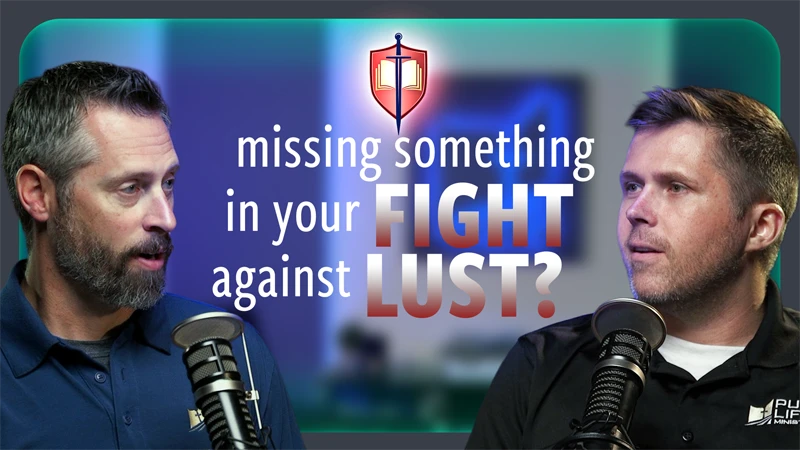
To Flee Sexual Sin, Pursue These Things | 2 Timothy 2:22 | Truths for Victory

July 16, 2026
Pure Life Ministries Podcast

Pure Life Ministries has been a pioneer in dealing with sexual addiction and its consequences for over 35 years. During that span of time thousands of people have found freedom through our counseling programs and teaching materials.

In Paul's final letter in Scripture, he urges Timothy to teach others to "flee from youthful lusts." This advice is a must to maintain a pure walk. But the evidence is clear that many in the church are, at worst, not fleeing, or at best, trying to flee but are stuck.

If you can't seem to break away from lust's powerful pull, Paul's instructions to Timothy on how to flee are exactly what you need to overcome!

Patrick: So, we're on Truths for Victory #3. And since you've let me open this one, I thought I'd just reiterate for people why we're doing this series. We are putting out a series right now of Youtube Shorts that I assume by the time this releases, some of them will have gone out. And we're taking a verse per short and expounding on how that scripture can speak to someone in sexual sin. And so, we’ve been wanting to produce midweek content on the podcast that really speaks to where people are at. And we thought, well, what if we just take those verses we chose for our Youtube shorts and have a conversation about them.
       And we thought the way that we would do that is start by discussing the context and then talking about the application. And at least my idea behind this was that people would see the power that the Word of God has to change them. And we are really just hoping to encourage people that if they get into the Word of God, it could really do something for their life. On the podcast, we have always been saying, “Get in the Word of God,” or, “Get into prayer.”  And so, this series is like a sneaky way of telling people to do that.

Josh: And it just works. I mean, if it's not broke, don't fix it.

Patrick: Yeah, exactly. So, the verse today, although I think we'll end up reading some others around it, is 2 Timothy 2:22

Josh: I love it. It's easy to remember. 2 Timothy 2:22.

Patrick: And it's a good one. It says, “Flee youthful passions and pursue righteousness, faith, love, and peace, along with those who call on the Lord from a pure heart.” So, Josh, why don't you kick us off with the context?

Josh: The letter of 2 Timothy was written by Paul. And this is his last letter that we have in Scripture before he was executed for the gospel. And I just found this interesting, in verse one, he writes, “Paul, an apostle of Christ Jesus by the will of God, according to the promise of life in Christ Jesus.” (2 Timothy 1:1, NASB 1995) And knowing that he's not going to have life anymore after this, you can tell that he wants to get some things off his chest in this letter. He wants to instruct Timothy one final time, perhaps. So, when he talks about the promise of life in Christ, knowing the context adds some more weight there because it's his final plea. So not only should it be read that way, it should be received that way. And I'm sure Timothy did receive it that way.
       So, these are his final instructions to him on how to minister, and it's also instruction for anyone reading this letter on how to train future ministers. In fact, 2 Timothy 2:2 says, “The things which you have heard from me in the presence of many witnesses, entrust these to faithful men who will be able to teach others also.” (2 Timothy 2:2, NASB 1995) So, Paul knows his time on earth is coming to an end. He's pretty much saying, “I've been training you. Now you go train others. Keep this thing going.” And as I read through the whole book of 2 Timothy over the past couple of days, I was trying to point out all the different direct instances where Paul is teaching, “Do this or do that.” And I found approximately 16 direct instructions. And this verse we are discussing, 2 Timothy 2:22, comes kind of in the middle of all of them.
       In 2 Timothy 2:20-21, Paul says, “Now in a large house there are not only gold and silver vessels, but also vessels of wood and of earthenware, and some to honor and some to dishonor. Therefore, if anyone cleanses himself from these things, he will be a vessel for honor, sanctified, useful to the Master, prepared for every good work.” (2 Timothy 2:20-21, NASB 1995) And I like to get into the King James sometimes and I like to get into the Greek. And in the King James, when Paul says, “If anyone cleanses himself.” the King James says, “If anyone purges himself.” And that word is only used one other time.
       Paul uses it in 1 Corinthians. He says, “Purge out therefore the old leaven, that ye may be a new lump.” (1 Corinthians 5:7, KJV) What he's saying is that a little sin goes a long way. He's saying that to the Corinthians, because they had a sexual sin problem come up in their church that they were not dealing with it properly. So, Paul had to step in and say, if you don't deal with this, if you don't take it out, if you don't purge it from you, it's going to spread throughout the whole church body.
       And so, in context, what Paul is talking about when he says, purge yourself from vessels of dishonor, he means, people who are using their bodies for dishonor. He is saying, remove yourself from them because bad company corrupts good morals. Eventually you're going to get involved in the same things as them if you don't take your walk with the Lord seriously. If a man cleanses and purges himself from these things, he's going to become a vessel of honor.
       And there's hope in that because you could be a vessel of dishonor. You could be using your body for unholy, ungodly things. But if you cleanse yourself, if you remove yourself from those other vessels, then you're going to sanctify yourself. You're going to become a vessel of honor, useful for the master, prepared for every good work. And so, to bring it back to 2 Timothy 2:22, when we talk about fleeing from youthful lusts, the purpose is not to just flee from it, but it's to prepare ourselves to become a vessel of honor, sanctified, useful for the master's use, prepared for every good work. And that should be what every genuine Christian wants to do.

Patrick: Yeah, strangely, verses 20 and 21 stood out to me almost more than verse 22. But I think what was really compelling to me was that a couple of commentators were really making the case that, the great house is not the church capital C, but it's all of Christendom. And so, they mentioned that in Matthew 13 and 14, there are the kingdom parables. You have the dragnet that catches fish that at the end of the age, some are discarded. And you have the parable about the wheat and the tares. And there are some other parables I can't remember.
       And that's what's going on here. You have vessels for dishonorable and honorable use, and they were making the case that, if you're a real Christian, you're not saying, “Well, I'm just a dishonorable-use Christian.” No, you're actually not part of that capital C church if you are a vessel for dishonorable use. But what you need to have happen is to be cleansed. And that’s just those verses. But when looking at the context, you kind of see that there are all these different analogies that Paul is making in this chapter, but he's building to the same idea.
       In 2 Timothy 2:3-4, he makes a soldier analogy. He says that soldiers don't get entangled in civilian affairs. And then he talks about how the athlete is only crowned when they compete according to the rules. And a farmer is only going to get his share of the crops if he works hard. So, you have these different contrasts given that are getting at the same thing. You have dishonorable vessels and you have honorable vessels. You have those living like the soldier, doing whatever they want. Or thinking they can get around the rules, like the athlete. Or the farmer saying, I don't have to work to get the harvest.
       That's the mindset that people have. And Paul is saying here, that's not the case. He talks about suffering as a Christian. And I know there's persecution, and he's about to be killed for his faith, but the whole Christian life is suffering. It's suffering against our flesh. And so, you get to 2 Timothy 2:22 telling us to flee youthful passions, and it's kind of a culmination in a way of all these different metaphors. Don't say to yourself, I can be a Christian and just do what everybody else is doing. No, you are called to be higher. You are called out of the world. And to put it simply, the way I would summarize it is, sexual sin is beneath a true Christian's character.

{{blog-bcall="/blog-ads-storage"}}

Josh: Yeah, that's true. And what does Paul say? He says that anybody who desires to live godly in this life will suffer persecution. And that’s because the world doesn't like what Christianity preaches. And on one hand, people loved Him as a person, but His teachings were very hard.

Patrick: Yeah, well, even now you see people who want the teachings of Christ. They like a lot of the words He said and they think He's a good person and a good model, but they don't want that first word of the gospel, “repent.” They don't want to see the cross for what it means as death to their self-life and their fleshly way of living.

Josh: Yeah. All right, so let's talk about how a true Christian should be applying 2 Timothy 2:22. So, Paul starts off saying, “Flee youthful lust.” It's pretty direct. He's not hiding anything. What you need to do is flee. So, what do you need to flee? Youthful lusts. And obviously we connect that with sexual sin. And that is what a lot of youthful lust is. You have the teenage hormones going on. There is a lot of sexuality that comes out in youth and you should flee it, but there is more to it than that. It's much more. It's also pride. It's also ambition. It's also power. And these things are not characteristic of the life of humility and the life of lowliness displayed by Jesus.
       And so, I was thinking, if someone's listening to us and is asking, “How do I flee?” Is it just simply running away like Joseph did with Potiphar's wife? Yeah, if there's a Potiphar's wife in your life, yeah, get out of the room, get out of there fast. Do we just limit what we do on the internet? Do we just put up filters? That's a smart thing to do. We're not against that at all. You should. But I feel like the most effective way of fleeing those youthful lusts is doing what Paul said in the last half. He said, “pursue.” Pursue righteousness, faith, love, and peace, along with those who call on the Lord from a pure heart.
       And so, we're just going to go back and forth here on those four things. I'll start, and then we'll just go back and forth.
       So, righteousness, what does that mean? Well, to pursue righteousness, Paul in Romans 6:13 says that we're to yield our members as instruments of righteousness. So, we take our bodies, we take our minds, and we use them for righteousness. Where we used to yield them to sin, we don't do that anymore. We yield them to righteousness.
       In Ephesians 6:14, it says that we are armed with the breastplate of righteousness. It protects us. It's part of what we use to fend off the enemy. And Proverbs 11:18-20 says, “The wicked earns deceptive wages, But he who sows righteousness gets a true reward. He who is steadfast in righteousness will attain to life, And he who pursues evil will bring about his own death. The perverse in heart are an abomination to the LORD, But the blameless in their walk are His delight.” (NASB 1995) So there are a lot of rewards that come with pursuing righteousness. What would you say?

Patrick: I was thinking about role models. Pursuing righteousness is obviously by the power of the Spirit, not in our own strength. But we're seeing God's criteria for life, especially modeled in Jesus, but also modeled in other godly people. And that's what I'm going to aim at. And I think the idea of a role model is maybe not as popular as it used to be. People more just say things like, “I just need to be true to myself.” And we can just settle into, “this is who I am. I can't be anything else.”
       And it's like, no, you can see virtue, honor, integrity, faith, love, peace, all these things that encompass righteousness. You can see it in the Word. You can see it in people who live those lives. And you say, “I'm going to strive to be like that.” Again, not in my own strength, but by the power of the Spirit. And that's not depressing and that's not going to put a burden on you. If you pursue it and you are asking the Lord to build it in you, what you're actually going to find is that it's going to encompass your life. It's going to make you a more beautiful person.

Josh: And righteousness is what? Righteousness is basically just right living. Right living according to God's way. That's simply what it is. I can get kind of mixed up on words like, what does that mean? But that's all that righteousness means. So, let's talk about faith.

Patrick: Well, I just did a two-part message on living by faith and not by feelings. And so that's the simple application that I wanted to make about this. I'm sure there's a lot more that this could cover, but basically, faith and trust, to me, are synonymous. So, I love the word “trust.” “Trust in the LORD with all your heart, And lean not on your own understanding; In all your ways acknowledge Him, And He shall direct your paths.” (Proverbs 3:5-6, NKJV)
       You know, you can feel so strongly about something. You're angry. You're frantic. You're worried. You're thinking, “This is the way it should go. I know this. I'm so set.” And it's like, well, hold on. That's all you. That's all your feelings. That's all your flesh. First, submit it to the Lord and learn what it means. It's a process. I'm still in it. I'm sure you relate. We need to learn to start with God first. Faith in Him first. Trusting in Jesus. Letting Him be the shepherd. So that's what struck me about that one.

Josh: Yeah. So, I think of, okay, we're to pursue faith. And so I was thinking, doesn't Christianity begin with faith? We're saved by grace through faith. There's more to it? Yeah, there is more to it. So, John Gill is an old Bible commentator and he put it like this, pursuing it as in “the veracity and truth in the preaching of the gospel.” Meaning, I believe this thing, so I need to pursue it and I need to tenaciously go after living out my faith. And so, as you're doing that, you're going to find that God is going to meet you. We live this life from glory to glory, so God's going to meet you the more often that you put faith in Him. If you think of old heroes of the faith that we read about, they were often put in situations where they had to just believe God and then God would show up in a big way.

Patrick: Well, so yeah, it's propelling you forward, right? And I think that the thing it propels you to is love in some ways.

Josh: That's a good transition. So, how do we pursue love? Well, there's love in two ways, love towards God and love towards man. Those are the two parts of the greatest commandment. So, to have love in your life and to want more of it and to desire more of it should be really an obvious trait, really for any Christian. It says in 1 Thessalonians 4:9, “You have no need for anyone to write to you, for you yourselves are taught by God to love one another.” (1 Thessalonians 4:9b, NASB 1995)
       So, it's pretty obvious that's what we need to be doing. But it can be hard. It's hard to love people because we see each other's sin. And it's important to remember that God sees every little thing that we do to love others. Even though people are hard to love, when we choose to love them in spite of how we see them, God sees that. Hebrews 6:10 says, “For God is not unjust so as to forget your work and the love which you have shown toward His name, in having ministered and in still ministering to the saints.” (Hebrews 6:10, NASB 1995) So, the more that we activate and actuate love in our life towards other people and toward God, we're going to be farther and farther away from those youthful lusts.

Patrick: Yeah. You know, when I was thinking about this, I was just thinking about how to simplify it. Sexual lust and any other form of lust is taking. Love is giving. We talk about mercy here a lot. But you mentioned how youthful passions or youthful lust is broader. It's pride. It's ambition. It’s power. But love is the opposite of all of those. I want sexually to take from someone. Well, instead of that, I'm going to let go of that, crush that, and say, “No, I want that other person built up.” And when it comes to ambition, you can go into a situation that's all about self-promotion and feel like, “Okay, I need to make connections.”  Well, you don't really need to approach things that way. You can actually go with the heart to build others up, love other people and have this radical faith that says, “I don't need to promote myself. I'm going to trust the Lord to lead me in whatever He wants to have happen.” It just takes the pressure off and it changes the whole way you live. If you start approaching life that way and you start pursuing faith and love in those ways, it'll totally eat away at those youthful lusts.

Josh: Yeah. So, if you're pursuing love with other people, there should be some peace going on.

Patrick: Yes. It should produce peace with other people. It might not. We talked about earlier in this conversation that there is suffering and there are trials in the Christian life. And that can happen when people are offended, or especially when non-Christians are offended. But as a general rule, if we are living righteously, if we are trusting in the Lord, if we are loving other people and we're not giving in to youthful passions, there'll be peace around us.
       And so, I was just thinking, it's kind of like a litmus test. How are your actions affecting other people? Is it producing strife with your wife or your children? Is it tense at work? Or what is going on internally? I'm not a really combative person by nature, but sometimes I start to get angry at people inside or worried on the inside. That's not peace with others. So, if you're lacking peace either externally with others or internally in your attitude towards others, it's a sign that there might be youthful passions at play.

Josh: Yeah. Well, it's just totally natural to not be at peace with people and to really have this division. Ambition, the lust for power and our pride can just naturally set us apart from other people in our hearts. And even as Christians, we can still do that with people. And so, Scripture reminds Christians constantly, “Hey, you need to have peace with others. Jesus has brought peace between you and God, so there needs to be that same peace between you and others.” It doesn't come natural to us. 1 Peter 3:11 says that we need to seek peace and pursue it. You literally need to go and find out what the way of peace is and then go after it.
       In Romans 12:18, Paul says, “If possible, so far as it depends on you, be at peace with all men.” (NASB 1995) So, we have to go against ourselves and say, “Okay, I know there's something between you and me. I'm going to do what I can for there to be peace.” That way, God can work in the situation.
       And in Matthew 5.9, Jesus said, “Blessed are the peacemakers, for they shall be called sons of God.” (NASB 1995) What a description of a person. You can be a son of God by just being a peacemaker. Seeking and pursuing that peace.
       And Paul finishes this out with not only those four things, but he says, “Do all of this with those who call on the Lord from a pure heart.” So, we're not supposed to do it alone. We are not supposed to be isolated. We're not supposed to act like we're imprisoned or anything like that, or set ourselves apart from people. We're communal beings. Even introverts need other people at some level in their life. Our relationships are critical.
       Who we spend our time with the most can directly affect our spiritual life and most often it does. I mentioned this earlier, “bad company corrupts good morals” in 1st Corinthians 15:33. And then Paul says, “Do not be unequally yoked with unbelievers.” So who we connect with, who we run this race with, is very critical and we are to do it with other believers, not just to be a lone Christian in the middle of nowhere, unless God puts us somewhere like that. God can call somebody to be a missionary somewhere or send us to evangelize to those who have never heard the gospel. But as much as we can help it, we are not do this Christian life alone.

Patrick: So to summarize, flee and pursue.

Learn More About Us

Biblical counseling is the heart and soul of our ministry.
We've been helping Christians fight for purity since 1986.
We release new content every week.
Close Icon

Subscribe

Subscribe for weekly update emails with the latest content from Pure Life Ministries.

Subscribe
Thank you! Your submission has been received!
Oops! Something went wrong while submitting the form.
Pure Life Ministries Podcast

This is the weekly purity podcast from Pure Life Ministries. Our show will take you where real life meets real Christianity as we tackle the tough issues for those struggling with sexual sin. Thanks for listening!

To Flee Sexual Sin, Pursue These Things | 2 Timothy 2:22 | Truths for Victory

To Flee Sexual Sin, Pursue These Things | 2 Timothy 2:22 | Truths for Victory

In Paul's final letter in Scripture, he urges Timothy to teach others to "flee from youthful lusts." This advice is a must to maintain a pure walk. But the evidence is clear that many in the church are, at worst, not fleeing, or at best, trying to flee but are stuck.

If you can't seem to break away from lust's powerful pull, Paul's instructions to Timothy on how to flee are exactly what you need to overcome!

Patrick: So, we're on Truths for Victory #3. And since you've let me open this one, I thought I'd just reiterate for people why we're doing this series. We are putting out a series right now of Youtube Shorts that I assume by the time this releases, some of them will have gone out. And we're taking a verse per short and expounding on how that scripture can speak to someone in sexual sin. And so, we’ve been wanting to produce midweek content on the podcast that really speaks to where people are at. And we thought, well, what if we just take those verses we chose for our Youtube shorts and have a conversation about them.
       And we thought the way that we would do that is start by discussing the context and then talking about the application. And at least my idea behind this was that people would see the power that the Word of God has to change them. And we are really just hoping to encourage people that if they get into the Word of God, it could really do something for their life. On the podcast, we have always been saying, “Get in the Word of God,” or, “Get into prayer.”  And so, this series is like a sneaky way of telling people to do that.

Josh: And it just works. I mean, if it's not broke, don't fix it.

Patrick: Yeah, exactly. So, the verse today, although I think we'll end up reading some others around it, is 2 Timothy 2:22

Josh: I love it. It's easy to remember. 2 Timothy 2:22.

Patrick: And it's a good one. It says, “Flee youthful passions and pursue righteousness, faith, love, and peace, along with those who call on the Lord from a pure heart.” So, Josh, why don't you kick us off with the context?

Josh: The letter of 2 Timothy was written by Paul. And this is his last letter that we have in Scripture before he was executed for the gospel. And I just found this interesting, in verse one, he writes, “Paul, an apostle of Christ Jesus by the will of God, according to the promise of life in Christ Jesus.” (2 Timothy 1:1, NASB 1995) And knowing that he's not going to have life anymore after this, you can tell that he wants to get some things off his chest in this letter. He wants to instruct Timothy one final time, perhaps. So, when he talks about the promise of life in Christ, knowing the context adds some more weight there because it's his final plea. So not only should it be read that way, it should be received that way. And I'm sure Timothy did receive it that way.
       So, these are his final instructions to him on how to minister, and it's also instruction for anyone reading this letter on how to train future ministers. In fact, 2 Timothy 2:2 says, “The things which you have heard from me in the presence of many witnesses, entrust these to faithful men who will be able to teach others also.” (2 Timothy 2:2, NASB 1995) So, Paul knows his time on earth is coming to an end. He's pretty much saying, “I've been training you. Now you go train others. Keep this thing going.” And as I read through the whole book of 2 Timothy over the past couple of days, I was trying to point out all the different direct instances where Paul is teaching, “Do this or do that.” And I found approximately 16 direct instructions. And this verse we are discussing, 2 Timothy 2:22, comes kind of in the middle of all of them.
       In 2 Timothy 2:20-21, Paul says, “Now in a large house there are not only gold and silver vessels, but also vessels of wood and of earthenware, and some to honor and some to dishonor. Therefore, if anyone cleanses himself from these things, he will be a vessel for honor, sanctified, useful to the Master, prepared for every good work.” (2 Timothy 2:20-21, NASB 1995) And I like to get into the King James sometimes and I like to get into the Greek. And in the King James, when Paul says, “If anyone cleanses himself.” the King James says, “If anyone purges himself.” And that word is only used one other time.
       Paul uses it in 1 Corinthians. He says, “Purge out therefore the old leaven, that ye may be a new lump.” (1 Corinthians 5:7, KJV) What he's saying is that a little sin goes a long way. He's saying that to the Corinthians, because they had a sexual sin problem come up in their church that they were not dealing with it properly. So, Paul had to step in and say, if you don't deal with this, if you don't take it out, if you don't purge it from you, it's going to spread throughout the whole church body.
       And so, in context, what Paul is talking about when he says, purge yourself from vessels of dishonor, he means, people who are using their bodies for dishonor. He is saying, remove yourself from them because bad company corrupts good morals. Eventually you're going to get involved in the same things as them if you don't take your walk with the Lord seriously. If a man cleanses and purges himself from these things, he's going to become a vessel of honor.
       And there's hope in that because you could be a vessel of dishonor. You could be using your body for unholy, ungodly things. But if you cleanse yourself, if you remove yourself from those other vessels, then you're going to sanctify yourself. You're going to become a vessel of honor, useful for the master, prepared for every good work. And so, to bring it back to 2 Timothy 2:22, when we talk about fleeing from youthful lusts, the purpose is not to just flee from it, but it's to prepare ourselves to become a vessel of honor, sanctified, useful for the master's use, prepared for every good work. And that should be what every genuine Christian wants to do.

Patrick: Yeah, strangely, verses 20 and 21 stood out to me almost more than verse 22. But I think what was really compelling to me was that a couple of commentators were really making the case that, the great house is not the church capital C, but it's all of Christendom. And so, they mentioned that in Matthew 13 and 14, there are the kingdom parables. You have the dragnet that catches fish that at the end of the age, some are discarded. And you have the parable about the wheat and the tares. And there are some other parables I can't remember.
       And that's what's going on here. You have vessels for dishonorable and honorable use, and they were making the case that, if you're a real Christian, you're not saying, “Well, I'm just a dishonorable-use Christian.” No, you're actually not part of that capital C church if you are a vessel for dishonorable use. But what you need to have happen is to be cleansed. And that’s just those verses. But when looking at the context, you kind of see that there are all these different analogies that Paul is making in this chapter, but he's building to the same idea.
       In 2 Timothy 2:3-4, he makes a soldier analogy. He says that soldiers don't get entangled in civilian affairs. And then he talks about how the athlete is only crowned when they compete according to the rules. And a farmer is only going to get his share of the crops if he works hard. So, you have these different contrasts given that are getting at the same thing. You have dishonorable vessels and you have honorable vessels. You have those living like the soldier, doing whatever they want. Or thinking they can get around the rules, like the athlete. Or the farmer saying, I don't have to work to get the harvest.
       That's the mindset that people have. And Paul is saying here, that's not the case. He talks about suffering as a Christian. And I know there's persecution, and he's about to be killed for his faith, but the whole Christian life is suffering. It's suffering against our flesh. And so, you get to 2 Timothy 2:22 telling us to flee youthful passions, and it's kind of a culmination in a way of all these different metaphors. Don't say to yourself, I can be a Christian and just do what everybody else is doing. No, you are called to be higher. You are called out of the world. And to put it simply, the way I would summarize it is, sexual sin is beneath a true Christian's character.

{{blog-bcall="/blog-ads-storage"}}

Josh: Yeah, that's true. And what does Paul say? He says that anybody who desires to live godly in this life will suffer persecution. And that’s because the world doesn't like what Christianity preaches. And on one hand, people loved Him as a person, but His teachings were very hard.

Patrick: Yeah, well, even now you see people who want the teachings of Christ. They like a lot of the words He said and they think He's a good person and a good model, but they don't want that first word of the gospel, “repent.” They don't want to see the cross for what it means as death to their self-life and their fleshly way of living.

Josh: Yeah. All right, so let's talk about how a true Christian should be applying 2 Timothy 2:22. So, Paul starts off saying, “Flee youthful lust.” It's pretty direct. He's not hiding anything. What you need to do is flee. So, what do you need to flee? Youthful lusts. And obviously we connect that with sexual sin. And that is what a lot of youthful lust is. You have the teenage hormones going on. There is a lot of sexuality that comes out in youth and you should flee it, but there is more to it than that. It's much more. It's also pride. It's also ambition. It's also power. And these things are not characteristic of the life of humility and the life of lowliness displayed by Jesus.
       And so, I was thinking, if someone's listening to us and is asking, “How do I flee?” Is it just simply running away like Joseph did with Potiphar's wife? Yeah, if there's a Potiphar's wife in your life, yeah, get out of the room, get out of there fast. Do we just limit what we do on the internet? Do we just put up filters? That's a smart thing to do. We're not against that at all. You should. But I feel like the most effective way of fleeing those youthful lusts is doing what Paul said in the last half. He said, “pursue.” Pursue righteousness, faith, love, and peace, along with those who call on the Lord from a pure heart.
       And so, we're just going to go back and forth here on those four things. I'll start, and then we'll just go back and forth.
       So, righteousness, what does that mean? Well, to pursue righteousness, Paul in Romans 6:13 says that we're to yield our members as instruments of righteousness. So, we take our bodies, we take our minds, and we use them for righteousness. Where we used to yield them to sin, we don't do that anymore. We yield them to righteousness.
       In Ephesians 6:14, it says that we are armed with the breastplate of righteousness. It protects us. It's part of what we use to fend off the enemy. And Proverbs 11:18-20 says, “The wicked earns deceptive wages, But he who sows righteousness gets a true reward. He who is steadfast in righteousness will attain to life, And he who pursues evil will bring about his own death. The perverse in heart are an abomination to the LORD, But the blameless in their walk are His delight.” (NASB 1995) So there are a lot of rewards that come with pursuing righteousness. What would you say?

Patrick: I was thinking about role models. Pursuing righteousness is obviously by the power of the Spirit, not in our own strength. But we're seeing God's criteria for life, especially modeled in Jesus, but also modeled in other godly people. And that's what I'm going to aim at. And I think the idea of a role model is maybe not as popular as it used to be. People more just say things like, “I just need to be true to myself.” And we can just settle into, “this is who I am. I can't be anything else.”
       And it's like, no, you can see virtue, honor, integrity, faith, love, peace, all these things that encompass righteousness. You can see it in the Word. You can see it in people who live those lives. And you say, “I'm going to strive to be like that.” Again, not in my own strength, but by the power of the Spirit. And that's not depressing and that's not going to put a burden on you. If you pursue it and you are asking the Lord to build it in you, what you're actually going to find is that it's going to encompass your life. It's going to make you a more beautiful person.

Josh: And righteousness is what? Righteousness is basically just right living. Right living according to God's way. That's simply what it is. I can get kind of mixed up on words like, what does that mean? But that's all that righteousness means. So, let's talk about faith.

Patrick: Well, I just did a two-part message on living by faith and not by feelings. And so that's the simple application that I wanted to make about this. I'm sure there's a lot more that this could cover, but basically, faith and trust, to me, are synonymous. So, I love the word “trust.” “Trust in the LORD with all your heart, And lean not on your own understanding; In all your ways acknowledge Him, And He shall direct your paths.” (Proverbs 3:5-6, NKJV)
       You know, you can feel so strongly about something. You're angry. You're frantic. You're worried. You're thinking, “This is the way it should go. I know this. I'm so set.” And it's like, well, hold on. That's all you. That's all your feelings. That's all your flesh. First, submit it to the Lord and learn what it means. It's a process. I'm still in it. I'm sure you relate. We need to learn to start with God first. Faith in Him first. Trusting in Jesus. Letting Him be the shepherd. So that's what struck me about that one.

Josh: Yeah. So, I think of, okay, we're to pursue faith. And so I was thinking, doesn't Christianity begin with faith? We're saved by grace through faith. There's more to it? Yeah, there is more to it. So, John Gill is an old Bible commentator and he put it like this, pursuing it as in “the veracity and truth in the preaching of the gospel.” Meaning, I believe this thing, so I need to pursue it and I need to tenaciously go after living out my faith. And so, as you're doing that, you're going to find that God is going to meet you. We live this life from glory to glory, so God's going to meet you the more often that you put faith in Him. If you think of old heroes of the faith that we read about, they were often put in situations where they had to just believe God and then God would show up in a big way.

Patrick: Well, so yeah, it's propelling you forward, right? And I think that the thing it propels you to is love in some ways.

Josh: That's a good transition. So, how do we pursue love? Well, there's love in two ways, love towards God and love towards man. Those are the two parts of the greatest commandment. So, to have love in your life and to want more of it and to desire more of it should be really an obvious trait, really for any Christian. It says in 1 Thessalonians 4:9, “You have no need for anyone to write to you, for you yourselves are taught by God to love one another.” (1 Thessalonians 4:9b, NASB 1995)
       So, it's pretty obvious that's what we need to be doing. But it can be hard. It's hard to love people because we see each other's sin. And it's important to remember that God sees every little thing that we do to love others. Even though people are hard to love, when we choose to love them in spite of how we see them, God sees that. Hebrews 6:10 says, “For God is not unjust so as to forget your work and the love which you have shown toward His name, in having ministered and in still ministering to the saints.” (Hebrews 6:10, NASB 1995) So, the more that we activate and actuate love in our life towards other people and toward God, we're going to be farther and farther away from those youthful lusts.

Patrick: Yeah. You know, when I was thinking about this, I was just thinking about how to simplify it. Sexual lust and any other form of lust is taking. Love is giving. We talk about mercy here a lot. But you mentioned how youthful passions or youthful lust is broader. It's pride. It's ambition. It’s power. But love is the opposite of all of those. I want sexually to take from someone. Well, instead of that, I'm going to let go of that, crush that, and say, “No, I want that other person built up.” And when it comes to ambition, you can go into a situation that's all about self-promotion and feel like, “Okay, I need to make connections.”  Well, you don't really need to approach things that way. You can actually go with the heart to build others up, love other people and have this radical faith that says, “I don't need to promote myself. I'm going to trust the Lord to lead me in whatever He wants to have happen.” It just takes the pressure off and it changes the whole way you live. If you start approaching life that way and you start pursuing faith and love in those ways, it'll totally eat away at those youthful lusts.

Josh: Yeah. So, if you're pursuing love with other people, there should be some peace going on.

Patrick: Yes. It should produce peace with other people. It might not. We talked about earlier in this conversation that there is suffering and there are trials in the Christian life. And that can happen when people are offended, or especially when non-Christians are offended. But as a general rule, if we are living righteously, if we are trusting in the Lord, if we are loving other people and we're not giving in to youthful passions, there'll be peace around us.
       And so, I was just thinking, it's kind of like a litmus test. How are your actions affecting other people? Is it producing strife with your wife or your children? Is it tense at work? Or what is going on internally? I'm not a really combative person by nature, but sometimes I start to get angry at people inside or worried on the inside. That's not peace with others. So, if you're lacking peace either externally with others or internally in your attitude towards others, it's a sign that there might be youthful passions at play.

Josh: Yeah. Well, it's just totally natural to not be at peace with people and to really have this division. Ambition, the lust for power and our pride can just naturally set us apart from other people in our hearts. And even as Christians, we can still do that with people. And so, Scripture reminds Christians constantly, “Hey, you need to have peace with others. Jesus has brought peace between you and God, so there needs to be that same peace between you and others.” It doesn't come natural to us. 1 Peter 3:11 says that we need to seek peace and pursue it. You literally need to go and find out what the way of peace is and then go after it.
       In Romans 12:18, Paul says, “If possible, so far as it depends on you, be at peace with all men.” (NASB 1995) So, we have to go against ourselves and say, “Okay, I know there's something between you and me. I'm going to do what I can for there to be peace.” That way, God can work in the situation.
       And in Matthew 5.9, Jesus said, “Blessed are the peacemakers, for they shall be called sons of God.” (NASB 1995) What a description of a person. You can be a son of God by just being a peacemaker. Seeking and pursuing that peace.
       And Paul finishes this out with not only those four things, but he says, “Do all of this with those who call on the Lord from a pure heart.” So, we're not supposed to do it alone. We are not supposed to be isolated. We're not supposed to act like we're imprisoned or anything like that, or set ourselves apart from people. We're communal beings. Even introverts need other people at some level in their life. Our relationships are critical.
       Who we spend our time with the most can directly affect our spiritual life and most often it does. I mentioned this earlier, “bad company corrupts good morals” in 1st Corinthians 15:33. And then Paul says, “Do not be unequally yoked with unbelievers.” So who we connect with, who we run this race with, is very critical and we are to do it with other believers, not just to be a lone Christian in the middle of nowhere, unless God puts us somewhere like that. God can call somebody to be a missionary somewhere or send us to evangelize to those who have never heard the gospel. But as much as we can help it, we are not do this Christian life alone.

Patrick: So to summarize, flee and pursue.

This is the weekly purity podcast from Pure Life Ministries. Our show will take you where real life meets real Christianity as we tackle the tough issues for those struggling with sexual sin. Thanks for listening!